Egyptian Prime Minister Calls for Dialogue, Joint Investments and Respect for International Law, Stressing That Development and Water Security Are Complementary Goals
Egyptian Prime Minister Mostafa Madbouly has stressed that achieving comprehensive cooperation among Nile Basin countries requires the participation of all basin states in cooperation frameworks, with downstream countries playing a full and active role in decisions that directly affect their water security.
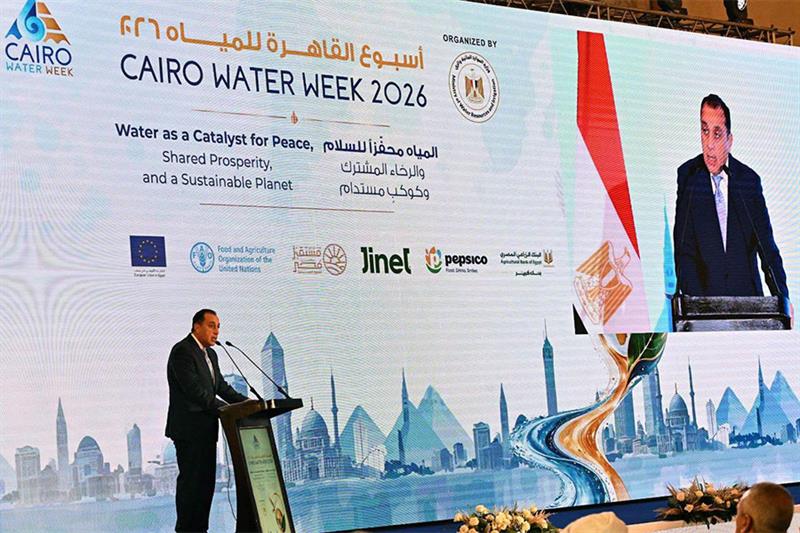
Speaking on behalf of President Abdel-Fattah El-Sisi at Cairo Water Week, Madbouly said cooperation and dialogue remain the most effective ways to address differences and strengthen confidence among Nile Basin countries.
“What we can achieve together is far greater than what any country can achieve alone amid disagreement and division,” he told representatives of the basin states.
Madbouly affirmed that Egypt seeks to be a partner in the development and success of neighbouring countries, emphasizing that supporting their development while safeguarding Egypt’s water security and the rights of its people are complementary objectives.
Nile Basin Initiative Offers Opportunity to Restore Consensus
The prime minister said ongoing consultations within the Nile Basin Initiative provide an important opportunity to address the concerns of countries that have not joined the Cooperative Framework Agreement, resolve outstanding issues and rebuild consensus among basin states.
He stressed that no cooperation framework in the Nile Basin can be genuinely inclusive without the participation of all countries, adding that downstream states must be full and active participants because their water security depends directly on the river’s flows.
Differences, he said, should lead to further consultations rather than bring dialogue to a halt. Building trust requires listening to the concerns of all parties and pursuing mutually acceptable solutions.
Egypt and Sudan have objected to the Cooperative Framework Agreement, arguing that it lacks consensus among all Nile Basin countries and is not binding on them.
Madbouly said Egypt wants the Nile Basin Initiative to remain an inclusive platform for cooperation and confidence-building, alongside a broader programme of joint projects and investment.
Joint Projects to Unlock the Basin’s Development Potential
The prime minister highlighted the considerable opportunities for cooperation among Nile Basin countries in rainwater, green water and groundwater resources, as well as renewable energy, electricity interconnections, trade and infrastructure.
He called for governments to work together to identify shared priorities and mobilize the financing and expertise needed to implement projects that deliver mutual benefits and promote sustainable development.
Madbouly cited Tanzania’s Julius Nyerere Dam and hydropower plant as a practical example of development through partnership. The project was built by an Egyptian consortium comprising Arab Contractors and Elsewedy Electric.
He added that supporting development across the basin requires practical cooperation rather than slogans, noting that Egypt’s partnerships with countries in the southern Nile Basin could provide a model for cooperation in the Eastern Nile Basin.
International Law and the Protection of Water Rights
Madbouly reiterated Egypt’s recognition of every country’s right to development and to benefit from its natural resources. However, he emphasized that when such resources include shared rivers, these rights must be exercised responsibly and in accordance with international law.
He identified consultation, prior notification, the completion of necessary environmental and social studies, and avoiding harm to the vital water security of countries sharing transboundary rivers as essential principles for cooperation.
Cooperation grounded in international law remains achievable, he said, describing it as the most effective path to reconciling development ambitions with the protection of countries’ vital interests.
The remarks followed Madbouly’s address to the United Nations in September, when he called for binding agreements governing shared water resources and rejected unilateral measures.
Egypt and Sudan have also reaffirmed their coordination on downstream water rights amid renewed discussions surrounding the Cooperative Framework Agreement.
Egypt Advances Domestic Water Management
Turning to domestic policy, Madbouly said President El-Sisi’s recorded address at the opening of Cairo Water Week had established a clear direction by identifying water as a fundamental pillar of national security and development.
“The government is working to translate this direction into policies and projects,” he said.
He noted that water management is closely connected to agriculture, industry, housing, energy and investment. The government is following the sector’s needs in coordination with the Minister of Water Resources and Irrigation, while relevant state institutions coordinate their efforts through the National Water Council.
Under the second generation of Egypt’s water management system, the government is working to upgrade water infrastructure, expand water treatment and reuse, and invest in human resources and modern technology.
These measures aim to improve services for citizens, farmers and investors while strengthening the efficiency and sustainability of water management, Madbouly said.
Preparing for the 2026 UN Water Conference
Madbouly described Cairo Water Week as one of the final major preparatory events ahead of the 2026 United Nations Water Conference, scheduled to take place in Abu Dhabi in December and co-hosted by the United Arab Emirates and Senegal.
Egypt aims to move from Cairo to Abu Dhabi with clearly defined priorities and initiatives that can be financed and implemented, he said, stressing that these efforts should reflect Arab and African needs and accelerate progress towards Sustainable Development Goal 6 on clean water and sanitation.
Egypt and Japan, which co-chair the conference’s “Water for the Planet” interactive dialogue, are working to advance discussions on water scarcity, climate adaptation and ecosystem protection.
The prime minister also welcomed Arab ministers participating in meetings of the Arab Ministerial Water Council and the seventh Arab Water Conference.
As Egypt prepares to assume the council’s next presidency, Madbouly called for joint programmes that build on Arab expertise in desalination, water treatment, modern irrigation and digital technology, alongside stronger international coordination.
He urged international partners to support dialogue and consensus through financing, technology transfer and capacity-building, emphasizing the need to translate the week’s discussions into practical partnerships and implementable projects.
Concluding his remarks, Madbouly reaffirmed Egypt’s commitment to a future for water built on cooperation, trust and respect for the rights and interests of all parties, stressing that sustainable development and the protection of water security must advance together.