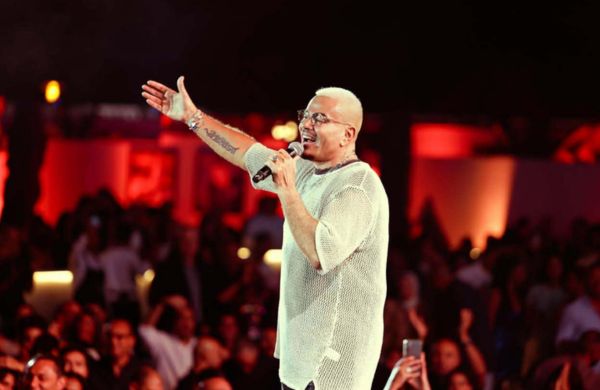
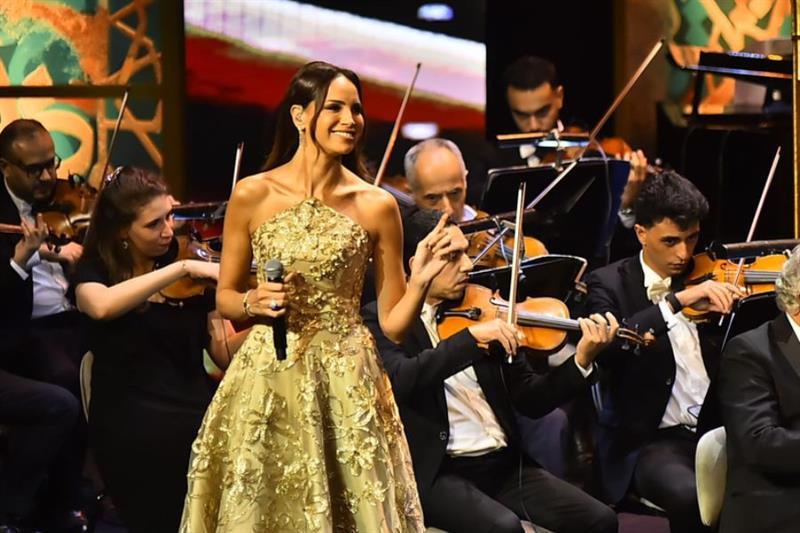
Egyptian singer Amal Maher performed to a sold-out audience at Cairo Opera House on Thursday as part of the 34th Arab Music Festival and Conference, accompanied by the United Philharmonic Orchestra and Choir under the baton of maestro Nader Abbassi.
The concert opened with a documentary about renowned Egyptian composer Riad Al-Sunbati, titled Amir Al-Nagham (Prince of Melody). The film was produced by Cairo Opera House’s editing studio under the artistic supervision of Samer Madi, with Rageh Fakhry serving as editor.
The evening also featured performances by Cairo Opera House singers Ahmed Mohsen, Noha Hafez, Enas Ezz El-Din and Mohamed El-Toukhy. They performed with the orchestra under conductor Ahmed Sherara, accompanied by violinist Hassan Sherara and ney player Reda Bedeir.
Their repertoire celebrated different generations of Egyptian music, bringing together classics associated with Abdel Halim Hafez, Mohamed Abdel Wahab and Um Kalthoum, alongside later popular songs. The segment concluded with the patriotic song Haskonek Ya Masr (We Will Keep You Within Us, Egypt).
Following these performances, Maher took to the stage to present a wide selection of her best-known songs, alongside celebrated works from the broader Arabic music repertoire.
A Blend of Contemporary Hits and Arabic Classics
Maher’s setlist featured several of her popular songs, including Neseet Esmi (I Forgot My Name), Etqi Rabena Feya (Fear God in Your Treatment of Me), Aref Menin (How Would I Know), Seket El-Salama (The Road to Safety) and Law Kan Bekhtiari (If It Were Up to Me).
She also paid tribute to the legacy of Arabic music through performances of Abdel Halim Hafez’s Ahwak (I Adore You) and Um Kalthoum’s Enta Omri (You Are My Life), combining contemporary favourites with classics that remain central to the festival’s identity.
Speaking to the audience, Maher described performing at Cairo Opera House as a source of pride and honour, recalling the venue’s importance in her artistic journey.
“It’s a source of pride and an honour to stand on the stage of Cairo Opera House, where I grew up,” she said.
The singer expressed gratitude to the festival’s organisers, including festival director Mohamed El-Mougy, Cairo Opera House chairman Reda El-Wakil and maestro Nader Abbassi. She also thanked her fans for their affection and continued belief in her talent, describing their support as a source of personal gratitude.
Nader Abbassi Praises Maher’s Performance
Following the concert, maestro Nader Abbassi shared a message to Maher on Instagram, describing the evening as “a night of imagination” and praising the singer’s exceptional voice.
Abbassi noted that the audience’s enthusiastic response reflected how much they had missed Maher, addressing her with the words, “It’s wonderful to have you home,” in reference to Cairo Opera House, where her artistic journey began.
He also thanked the musicians and everyone involved in bringing the performance to the stage, expressing pride in the team’s contribution to the evening.
Maher has maintained a prominent presence at the Arab Music Festival in recent years. In October 2025, she headlined the opening concert of the festival’s 33rd edition, performing Um Kalthoum’s Alf Leila wa Leila alongside songs from her own repertoire.
Arab Music Festival Continues Through 30 October
Maher’s concert was among the highlights of the 34th Arab Music Festival and Conference, which continues until 30 October with a programme of performances by leading Egyptian and Arab singers and musicians.
The upcoming schedule includes Ali El-Haggar at Cairo Opera House on 24 October, followed by performances by Mohamed El-Helou and Nadia Mostafa on 25 October.
Iraqi singer Hammam Ibrahim is scheduled to perform alongside Yasmine Ali in Cairo on 27 October, while composer Omar Khairat will take the stage on 28 October with an orchestra conducted by Nayer Nagui.
On 29 October, Tunisian singer Yosra Mahnouch is set to perform with Mohamed Shahin, before Medhat Saleh closes the festival in Cairo on 30 October, accompanied by pianist Amr Selim and an orchestra conducted by Ahmed Amer.
Through its blend of established performers, emerging talent and celebrated works from the Arabic musical tradition, the festival continues to highlight the region’s musical heritage while bringing audiences together around a shared cultural legacy.