
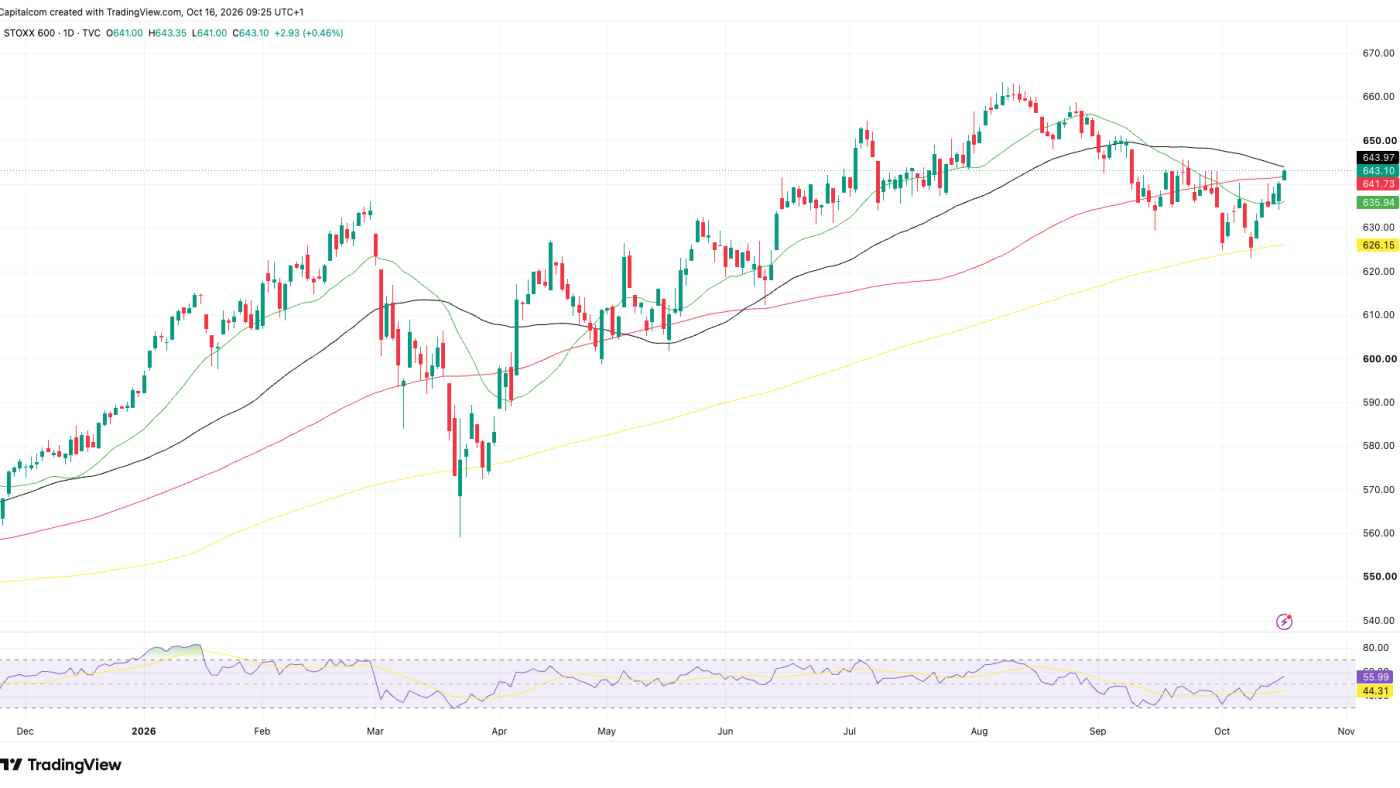
Global equity markets are closing a bruising week on a steadier footing, but the widening gap between regions is becoming increasingly striking. US and Asian stocks have absorbed the sharpest losses after hotter-than-expected US inflation drove Treasury yields higher and reignited concerns over the debt-fuelled expansion of the AI boom. The Nasdaq has proved especially vulnerable as investors question whether future AI returns can justify stretched valuations and increasingly costly financing. CoreWeave emerged as the flashpoint after yields on some of its debt moved into distressed territory, prompting a broader reassessment of highly leveraged AI infrastructure companies.
Europe, by contrast, has emerged as the week’s notable outperformer—benefiting from what was once seen as one of its greatest weaknesses: limited exposure to the AI trade. European indices are more heavily weighted towards healthcare, financials, industrials and other value and defensive sectors, leaving them less exposed to the sharp repricing of long-duration technology stocks. More modest valuations have provided an additional buffer against rising global yields. Europe’s structural challenges—from weak growth and fiscal pressures to political uncertainty—have not disappeared, but this week has offered a powerful reminder of the value of diversification when the concentrated US technology trade comes under strain.
The AI trade found some relief towards the end of the week after Nvidia CEO Jensen Huang pushed back against concerns surrounding CoreWeave, arguing that its financial position is improving and that Nvidia does not need to provide an additional financial backstop. CoreWeave subsequently rebounded from its lows, while Asian technology stocks recovered on Friday. The comments helped defuse immediate fears, but they did not settle the larger question now confronting markets: how sustainable is an AI infrastructure boom built on vast amounts of debt when the risk-free rate is above 5%? Huang may have eased the sense of crisis, but the next test will come from Big Tech earnings. Companies must now prove that record AI investment can generate the revenue and cash flow needed to justify both its scale and its cost.