Egypt’s iconic solar alignment highlights Aswan’s tourism appeal as the country targets 20 million visitors and more than $20 billion in tourism revenues in 2026
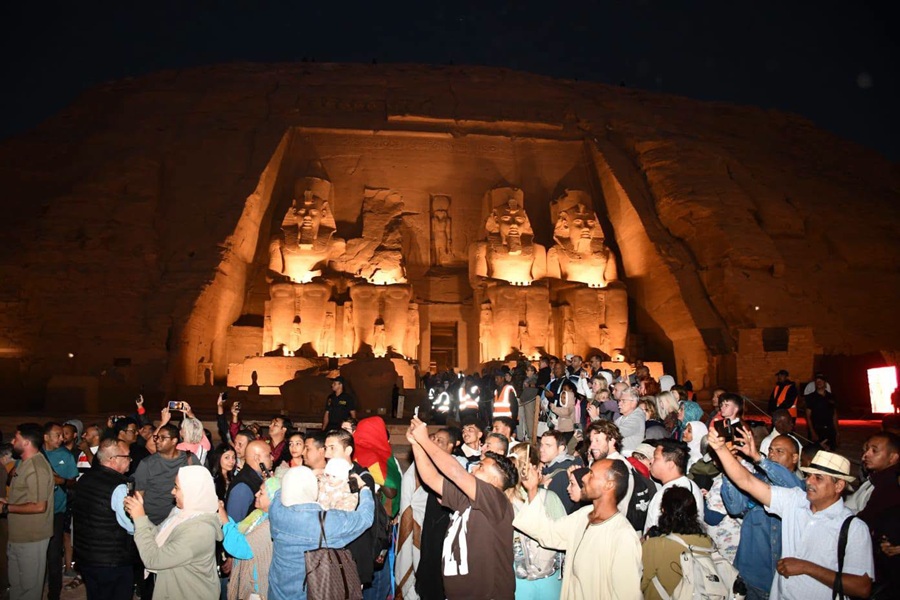
Around 7,000 tourists gathered at the Abu Simbel temples in Aswan on Thursday to witness one of ancient Egypt’s most remarkable astronomical phenomena, as sunlight illuminated the face of King Ramses II during the twice-yearly solar alignment, Aswan Governor Amr Lashin said.
The phenomenon lasted approximately 20 minutes, with sunlight travelling nearly 60 metres through the temple’s interior before reaching the sanctuary at 6:53 a.m. The event once again highlighted the archaeological significance of Abu Simbel and its role in promoting Egypt as a leading cultural tourism destination.
The turnout followed the arrival of approximately 3,000 tourists at Abu Simbel Airport a day earlier on 10 flights, as local authorities intensified preparations to accommodate visitors attending the event.
During the alignment, sunlight illuminated three of the four seated statues inside the sanctuary: Ramses II, Amun-Re and Re-Horakhty. The statue of Ptah, the ancient Egyptian god associated with darkness, remained in shadow.
Ahmed Massoud, director of the Abu Simbel antiquities area, said preparations had included cleaning the temple and maintaining its lighting systems in the weeks leading up to the event.
Governor Lashin said Aswan Governorate had coordinated with security authorities and the relevant culture, tourism, antiquities, civil aviation, supply and health agencies to ensure smooth visitor access and movement. Designated entrances and routes were established to manage the flow of tourists around the temple.
As part of the celebrations, the General Authority for Cultural Palaces organised a festival running from 17 to 22 October, featuring six Egyptian folk-art troupes. A large screen installed outside the temple hall also enabled visitors to follow the solar alignment from the surrounding grounds.
The Ministry of Tourism and Antiquities introduced special admission prices for the two annual alignment dates, with tickets priced at EGP 1,200 for foreign adults and EGP 60 for Egyptian adults.
Tourism Growth Supports Egypt’s Economic Ambitions
The event comes as Egypt seeks to strengthen tourism’s contribution to foreign-currency earnings and economic growth. International tourist arrivals increased by 3% in the first half of 2026, according to UN Tourism.
Tourism Minister Sherif Fathy has projected that Egypt will welcome approximately 20 million tourists by the end of 2026, compared with around 19 million visitors in 2025. Tourism revenues are also expected to exceed $20 billion this year, according to the minister.
In a separate development, Egypt is set to introduce higher ticket prices at the Grand Egyptian Museum starting 1 November, as the country continues to develop its archaeological attractions and tourism infrastructure.
A Legacy of Ancient Engineering and Global Heritage
The Abu Simbel solar alignment takes place annually on 22 February and 22 October, when the rising sun’s rays penetrate the temple and illuminate the statues inside the sanctuary. The dates shifted by one day following the relocation of the temples in the 1960s.
In 1960, UNESCO launched an international campaign to save the Nubian monuments from the rising waters of Lake Nasser, created by the construction of the Aswan High Dam. The temples were carefully cut into blocks, moved to higher ground and reconstructed in a major international conservation operation.
Abu Simbel forms part of the Nubian Monuments from Abu Simbel to Philae, which were inscribed on UNESCO’s World Heritage List in 1979.
Egypt’s next major astronomical attraction is expected to be the total solar eclipse on 2 August 2027, which will cross parts of the country, including Luxor and Siwa, offering another opportunity to attract international visitors and promote Egypt’s cultural and natural heritage.