Egyptian president calls for merit-based selection of qualified cadres for senior government positions, rejects claims of preparing a relative to succeed him, and stresses constitutional continuity
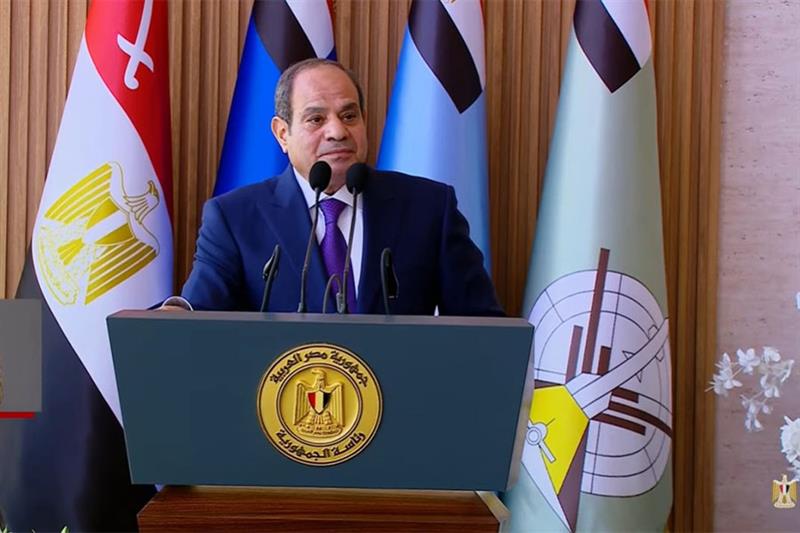
Egyptian President Abdel-Fattah El-Sisi on Saturday proposed establishing a comprehensive programme through the Egyptian Military Academy to prepare qualified cadres for leadership positions across the state, while reaffirming that his presidential term would end in 2030 and that the Constitution would remain unchanged.
Speaking at a graduation ceremony for the academy’s first cohort and new batches of military college graduates in the New Administrative Capital, El-Sisi reiterated his commitment to respecting the Constitution and ending his presidency at the conclusion of his current term.
“Leaving the Constitution untouched is the right course. In 2030, my term leading the country will end, if I am still alive. This matter is completely settled and will not be discussed further,” he said.
The president added that he wanted to ensure the state would have a generation of qualified Egyptians capable of assuming responsibility and leading its institutions.
“I will not leave the Egyptian state until it is brimming with its own people capable of shouldering responsibility,” he said.
Programme to Prepare Qualified Candidates for Leadership
El-Sisi outlined a proposed training and qualification programme lasting up to 30 months and comprising more than 7,500 hours of training. The initiative would aim to prepare qualified personnel for leadership responsibilities in the presidency, government ministries, parliament, governorates, and other vital state institutions.
He said a dedicated committee would establish the programme’s admission criteria, emphasizing that selection must be based on competence, merit, and impartial standards rather than personal connections or favouritism.
The proposed programme would target doctorate holders graduating from reputable Egyptian or international universities, with applicants aged between 40 and 50 required to pass admission examinations.
El-Sisi suggested that the programme could accommodate between 200 and 1,000 participants, depending on the final design and capacity. Its objective would be to deepen participants’ understanding of the state, its resources, and the responsibilities involved in managing and protecting national assets.
He added that individuals with six or more years of government service could be exempted, explaining that their professional experience would already equip them to assume senior responsibilities, including leading ministries or the government.
The president said the Armed Forces would bear the programme’s costs, regardless of the amount required.
The Military Academy already provides training for state personnel, including members of judicial bodies, alongside its military education programmes.
El-Sisi Rejects Claims of Preparing a Family Successor
The president dismissed suggestions that the proposed initiative was intended to prepare a family member or relative to assume leadership of Egypt.
“No one should engage in political one-upmanship and say that I am preparing someone from my relatives or family,” he said, describing such claims as inappropriate for a country of Egypt’s stature.
He stressed that the initiative was intended to develop a new generation of capable leaders rather than serve any individual or family interest.
El-Sisi said he was announcing the proposal more than 40 months before the end of his presidential term to prevent speculation and political manoeuvring surrounding the country’s future leadership.
He called on Egyptians to support the preparation of qualified individuals capable of serving in the presidency, ministerial positions, parliament, governorates, and other key institutions.
The president emphasized that managing the state requires more than political rhetoric, arguing that candidates must possess the knowledge, experience, and practical capabilities necessary to assume responsibility.
“Egypt is not incapable of producing people a hundred times better than me, provided we work on preparing, educating and qualifying them to shoulder responsibility,” he said.
He added that the initiative was intended to strengthen state institutions and ensure that those entrusted with public responsibilities possess the necessary qualifications and integrity.
Proposed Legislation and Constitutional Safeguards
El-Sisi called for the preparation of legislation establishing a clear legal framework for selecting and qualifying candidates who meet the required standards.
He suggested that the Speaker of the House of Representatives, alongside a group of intellectuals and politicians and the ministers of higher education and justice, should contribute to drafting the proposed legislation.
The president also highlighted the constitutional provisions defining the responsibilities of the Armed Forces, noting that he had insisted on including language affirming their role in protecting the state and its constitutional foundations.
The provisions describe the Armed Forces as belonging to the Egyptian people and responsible for safeguarding the country, its security and territorial integrity, the Constitution, democracy, the civilian character of the state, national achievements, and individual rights and freedoms.
They also establish that the state alone may form the Armed Forces and prohibit individuals, organizations, or groups from establishing military or paramilitary formations.
El-Sisi said these safeguards were intended to protect Egypt against attempts to infiltrate state institutions or place the country under the leadership of individuals lacking the necessary capabilities to manage its affairs.
He stressed that preserving constitutional institutions and ensuring competent leadership were essential to the country’s stability and future.
National Unity and the Role of State Institutions
Congratulating the graduates and expressing appreciation to their families, El-Sisi emphasized that protecting the homeland is a shared national responsibility that begins within the Egyptian family.
He described the family as the foundation for shaping citizens’ values, strengthening national identity, and preparing future generations to contribute to society.
The president said regional and international developments had demonstrated that preserving the nation-state and its stability requires strong institutions capable of protecting national resources and serving their citizens.
He described the Armed Forces as a central pillar of national security and the country’s “shield and sword,” stressing that safeguarding the institution is a national responsibility shared by all Egyptians.
El-Sisi emphasized that the Armed Forces are an integral part of Egyptian society, comprising citizens from across the country and reflecting the aspirations and will of the Egyptian people.
He also warned against attempts to undermine public confidence in national institutions, saying that citizens’ awareness had repeatedly helped preserve the cohesion and stability of the Egyptian state.
El-Sisi Pays Tribute to Gulf Countries for Their Support
In a separate part of his address, El-Sisi praised Saudi Arabia, the United Arab Emirates, and Kuwait for their support for Egypt during periods of severe economic difficulty following the events of 2011.
He recalled the economic pressures facing the country at the time, including depleted foreign reserves, a contraction in economic activity, and shortages of essential supplies.
El-Sisi said Gulf countries had provided assistance in 2013 through shipments of oil, gas, liquefied petroleum gas, and wheat, describing their support as instrumental during a critical period.
He expressed gratitude to the three countries, emphasizing the importance of acknowledging their assistance and preserving strong relations with Egypt’s Gulf partners.
The president also urged Egyptians to avoid disparaging Gulf countries on social media, stressing that their support during difficult circumstances should not be forgotten.
He said recalling these events was intended to reinforce gratitude, strengthen regional ties, and remind Egyptians of the importance of preventing a recurrence of the crises the country had experienced.
Preparing Future Leaders as a National Priority
El-Sisi’s proposal places leadership development, institutional continuity, and merit-based qualification at the centre of a broader discussion about Egypt’s future governance.
The proposed programme would seek to expand the pool of qualified candidates for senior public positions through structured training, transparent selection criteria, and a deeper understanding of state administration.
The president’s remarks also reaffirmed his stated intention to leave office in 2030 without changing the Constitution, while underscoring the importance of strong national institutions, political responsibility, and regional partnerships in preserving Egypt’s stability and supporting its long-term development.