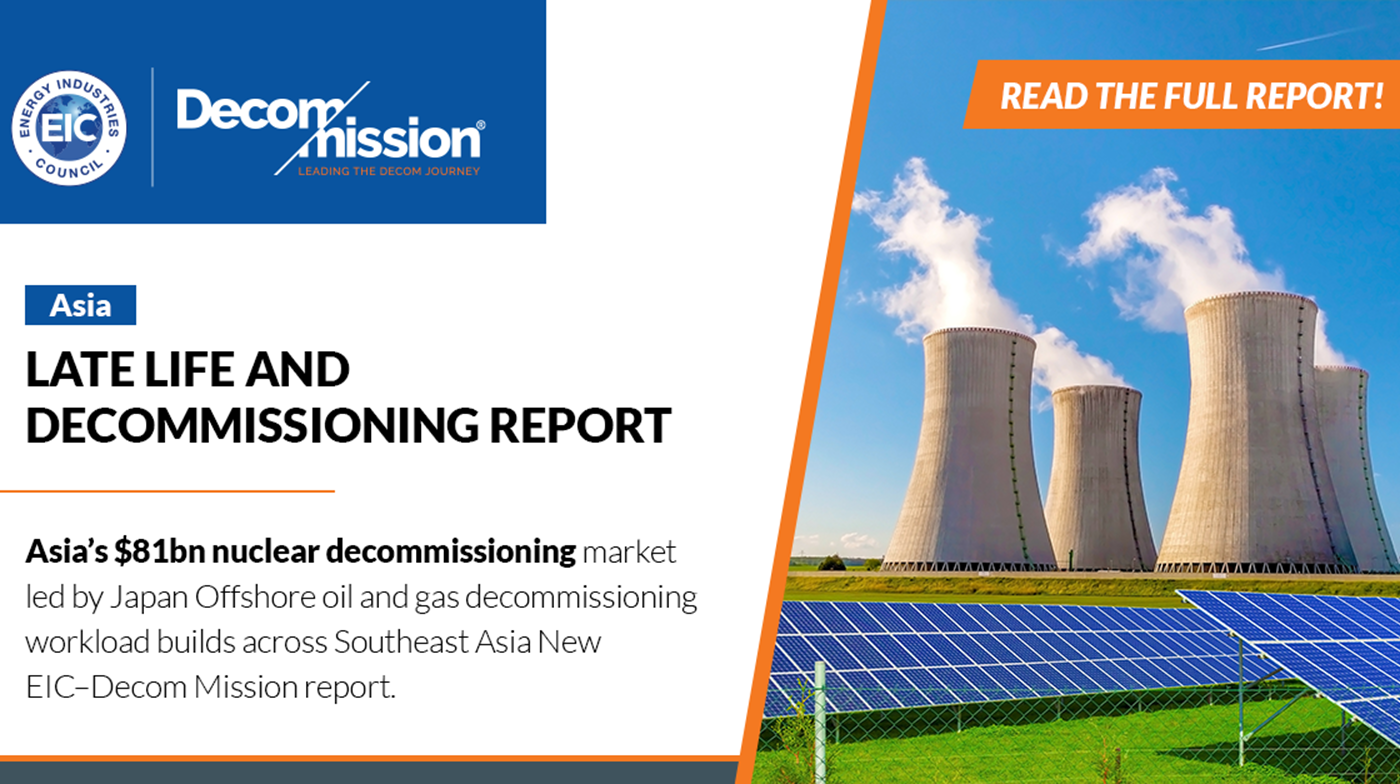
Asia boasts about $81bn in nuclear decommissioning work across 61 units, with $72bn of that already awarded. This comes as ageing offshore oil and gas infrastructure is creating a second major end-of-life market across the region, according to a new report from the Energy Industries Council (EIC) and Decom Mission.
The Asia Late Life and Decommissioning Report, the second instalment in the organisations’ joint regional series, shows that 46.8GW of nuclear capacity is undergoing some form of decommissioning. Japan is the dominant market and its Fukushima Daiichi programme accounts for about $54bn, or 75% of the awarded nuclear total identified in the report.
The EIC is a world-leading trade association for energy supply chain companies, providing global project data, market intelligence, industry events and insights. Decom Mission is a not-for-profit trade association specialising in end-of-life and decommissioning activities across the energy sector.
In oil and gas, more than 2,000 offshore assets are operating across Asia from approximately 650 offshore fields, and these incorporate thousands of wells. About 200 of these assets are no longer producing and they either await or have already undergone decommissioning.
Brunei, Indonesia, Malaysia and Thailand have approximately 200 offshore fields comprising more than 1,500 platforms and 7,000 wells. The report estimates the eventual decommissioning costs across this part of Southeast Asia at between US$30bn and US$100bn.
Malaysia has more than 300 offshore platforms, with about 43% of them now over 30 years old. Brunei has more than 1,200 offshore and onshore wells that need plugging and abandonment over the next decade. As for Thailand, there is already substantial execution experience, with more than 3,500 wells having already been decommissioned and more than 100 more assets expected to be retired over the coming decade.
That difference in market maturity extends to regulation, but the report points out that Thailand is the most advanced in this regard, having had dedicated decommissioning requirements in place since 2016.
EIC CEO Stuart Broadley commented:
“The report presents the kind of data that our members and the wider industry need and look for, which shows how markets even within the same region can differ considerably. The report shows that we certainly can’t treat Asia as a single decommissioning market. Nuclear work is already substantial and heavily contracted, while offshore oil and gas presents us with a different picture, with a huge volume of infrastructure moving towards late life across several Southeast Asian countries.”
He added, “The key thing for the supply chain is where that work is actually moving towards execution, what capability already exists locally and where specialist expertise is still needed. That needs careful consideration, and the report provides some great insights into that.”
The report shows that Asia is not all about decommissioning and that new work is being rolled out. Coal-fired generation, for example, is still expanding or being kept online in several markets, while many hydroelectric assets are given a new lease of life rather than being retired. As for offshore wind, the technology is relatively nascent in the region and the report does not expect significant field-wide repowering or decommissioning before approximately 2035.
Onshore wind is expected to reach that point sooner, especially in Japan. But the report points out that Asia lacks enough processing facilities to receive and handle retired turbine blades, capacity that will need to grow as more wind assets reach end of life.
Decom Mission CEO Sam Long commented:
“The scale of work is significant, but timing is everything in decommissioning. A platform or plant reaching a certain age does not mean we have a fresh decommissioning contract. There are multiple other factors that lead to that decision, including regulation, asset economics, life-extension decisions and local execution capacity.”
“That is particularly clear in Asia, where mature decommissioning markets coexist with countries that are just beginning to establish the regulatory frameworks and supply chain they will need.”
The report combines project and asset information from the EIC’s EICDataStream and EICAssetMap databases with market commentary and industry knowledge from Decom Mission. The series looks at decommissioning across energy sectors on a region-by-region basis, including the timing of activity, supply-chain capability and the factors affecting execution.