
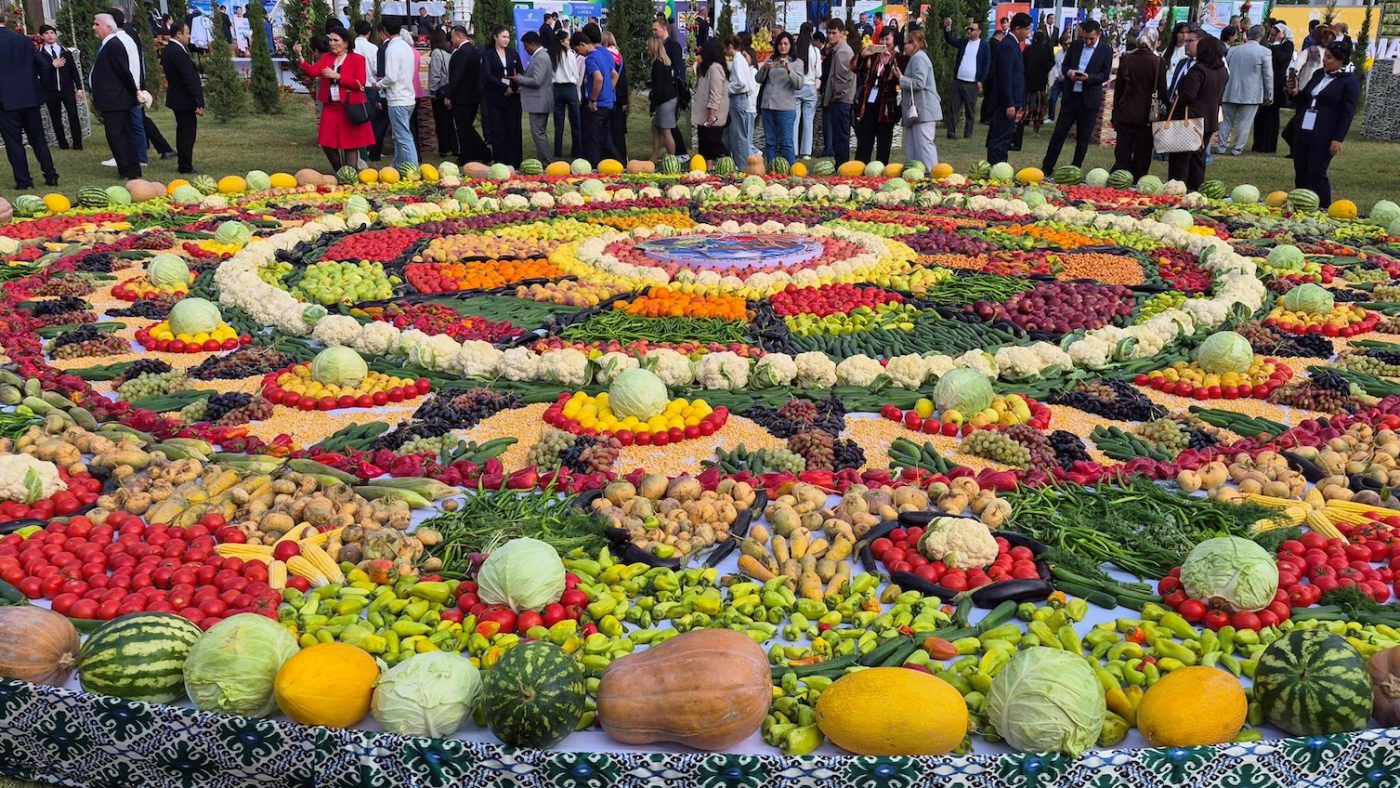
Against a festive backdrop reflecting the depth of Tajik culture and the close relationship between people, land and nature, the International University of Tourism and Entrepreneurship in Dushanbe yesterday hosted the Mehrgon Festival, one of the oldest seasonal celebrations in Tajik culture, coinciding with the launch of the International Forum on Sustainable Tourism and Cultural Heritage.
The university’s courtyards and halls were transformed into vibrant spaces showcasing local agricultural products, traditional crafts and folk arts, creating what appeared to be a visual journey into the heart of Tajik society and traditions passed down through generations.
The Mehrgon Festival was organised as part of the opening programme of the international forum, hosted by the International University of Tourism and Entrepreneurship in Tajikistan from October 13 to 18, with broad international participation. The forum brings together around 2,000 officials, academics, experts, investors and representatives of various institutions from more than 60 countries.
A Celebration of Land and People
From the moment visitors entered the festival grounds, it was clear that Mehrgon was more than a traditional celebration. It was an occasion through which Tajikistan revisited an authentic part of its cultural and civilisational memory.
The exhibition pavilions were adorned in the colours of autumn, with farmers and local producers displaying a wide variety of fresh fruits and vegetables for which Tajikistan’s agricultural regions are renowned, alongside food products and other items associated with the harvest season.
Agricultural produce featured prominently, reflecting the essence of Mehrgon and its longstanding connection with the land and the harvest — values that have been associated with the festival for centuries.
The celebrations extended beyond agriculture and local produce to traditional handicrafts, an important component of Tajikistan’s cultural identity.
Visitors viewed examples of pottery, gold craftsmanship, wood carving, traditional embroidery and the distinctive Chakan embroidery, as well as a variety of handmade products inspired by the country’s cultural heritage.
The exhibits offered a vivid picture of the skills of Tajik artisans and demonstrated how traditional industries have survived and evolved despite the economic and social transformations the region has experienced over recent decades.
Heritage as a Gateway to Tourism
Perhaps the most striking aspect of the Mehrgon Festival was that it was held at a university specialising in tourism and entrepreneurship, on the same day that an international forum addressing the future of sustainable tourism and the protection of cultural heritage got underway.
Here, heritage appeared to move beyond being merely a historical memory to become an economic and tourism asset capable of creating new experiences for visitors.
Today’s traveller is not looking only for hotels and conventional tourist attractions. Increasingly, visitors want to experience the destination itself, discover its customs, cuisine, crafts, arts and markets, meet its people and understand how local communities live.
From this perspective, Mehrgon provides an important example of how cultural and agricultural celebrations can be transformed into tourism products that enhance a destination’s appeal while supporting local communities.
Displaying agricultural products and traditional crafts to international visitors attending the forum also provided an opportunity to showcase Tajikistan’s potential in rural, agricultural, cultural and craft tourism.
The decision to make Mehrgon part of the forum’s opening programme reflects a clear vision of linking academic discussions and tourism policies with the living heritage practised by communities in their everyday lives.
Sustainable tourism does not begin only with government strategies or major investments. It also begins with protecting traditional crafts, supporting farmers, preserving culinary heritage and transferring skills from one generation to the next.
Dushanbe.. A Capital Celebrating Its Heritage
Through this event, Dushanbe appeared to be presenting itself to guests from around the world in a way that went beyond the conventional image of a modern capital.
Alongside its urban infrastructure, modern buildings and broad avenues, the city retains a rich cultural heritage that remains visible in everyday life — from clothing and cuisine to crafts and seasonal celebrations.
Mehrgon provided an opportunity to showcase this dimension to forum participants, including academics, government officials, tourism experts, investors and representatives of international organisations.
For Arab and international visitors, such events offer an opportunity to understand Tajikistan from within, beyond stereotypes, and to discover a country with a unique combination of mountain landscapes, history, culture, agriculture and traditional crafts.
A Field Experience
The celebration was not merely a formal display arranged for visiting guests; it carried a distinctly popular and community-based spirit.
The fruits and vegetables, handicrafts, traditional clothing and cultural elements spoke of Tajikistan in a way that words alone could never fully convey.
Mehrgon represents an open window into Tajik society, demonstrating how heritage can become a universal language of communication among peoples.
A visitor arriving in Tajikistan in search of mountains, lakes and natural beauty may also find themselves discovering a rich culture worthy of exploration, together with human stories rooted in the land, the seasons, family and community.
From Celebration to Tourism Economy
The importance of Mehrgon also lies in its potential to provide a practical model for sustainable tourism.
When agricultural products, handicrafts and traditional foods become part of the visitor experience, the economic benefits extend beyond tourism companies and hotels to farmers, artisans, home-based producers and local communities.
This form of tourism can help create new employment opportunities, encourage young people to develop small businesses and preserve crafts that might otherwise face the risk of disappearing.
Annual heritage celebrations can also become permanent features on the international tourism calendar, encouraging visitors to travel to Tajikistan during specific seasons to experience these celebrations, alongside visits to its historical and natural attractions.
A Cultural Message to the World
Ultimately, the Mehrgon Festival in Dushanbe conveyed a message that went far beyond the celebration of the harvest season.
It was a celebration of people, nature and heritage — and a reminder that genuine tourism development does not require abandoning cultural identity. On the contrary, it can be built upon protecting that identity and presenting it to the world in a contemporary way.
The International University of Tourism and Entrepreneurship succeeded in placing this message at the heart of the International Forum on Sustainable Tourism and Cultural Heritage, reaffirming that the future of tourism cannot be separated from the past, and that heritage can serve as a bridge to development rather than simply a record of memory.
Amid the colours of fruits and vegetables, the aromas of traditional foods, the intricate embroidery and the beauty of handmade crafts, the Mehrgon Festival seemed to deliver a simple message to every visitor: