
Global markets are approaching the end of another volatile week, with uncertainty surrounding Federal Reserve policy, renewed geopolitical tensions and developments at Nvidia creating significant swings across equities, bonds and commodities. However, despite the negative headlines, the performance of US stock indices has been surprisingly resilient. Investors appear increasingly willing to distinguish between company-specific risks and the broader economic outlook, although next week’s Nvidia earnings could provide another major test of confidence in the AI investment cycle.
This week: Stock markets rebound, but confidence remains fragile
US equities have recovered much of the ground lost during the previous week’s sharp selloff. Monday’s session provided the strongest indication that investors were willing to return to risk assets, with the S&P 500 gaining 2.3% and the Nasdaq advancing 2.7%, supported by falling oil prices and renewed buying in technology stocks. The recovery has been uneven, however, with Thursday’s session bringing fresh selling pressure as rising Treasury yields and uncertainty surrounding Nvidia unsettled investors. Despite this, the Nasdaq was still up around 3.2% for the week through Thursday’s close, suggesting that the broader recovery has not been entirely derailed.
The standout development has been the market’s ability to absorb Nvidia’s leadership crisis without triggering another widespread technology selloff. Jensen Huang’s resignation initially sent Nvidia shares sharply lower, but the stock recovered significantly from its intraday lows as bargain hunters stepped in. More importantly, other semiconductor companies have shown considerable resilience, suggesting investors are not necessarily abandoning the AI investment theme. Instead, there appears to be a rotation within technology, with investors reassessing which companies are best positioned to benefit from continued infrastructure spending. Nevertheless, Nvidia’s leadership transition introduces genuine uncertainty around strategy, customer relationships and execution at a particularly sensitive moment for the sector.
The other major development has been the sharp repricing of US interest rate expectations following Tuesday’s hotter-than-expected CPI report. Markets now view a December Federal Reserve rate hike as virtually certain, while the possibility of a larger 50-basis-point increase has entered the discussion, although it remains a relatively low-probability outcome. The two-year Treasury yield has risen sharply as investors reassess how much further the Fed may need to tighten, while the 10-year yield has climbed above 5.1%. The concern for equities is that higher yields could undermine valuations just as investors are becoming more demanding about corporate earnings and AI profitability.
Nasdaq (US Tech 100) daily chart

Oil and gold: A volatile week for commodities
Oil markets have experienced another dramatic week, with Brent initially falling towards $89 as hopes of progress in US-Iran negotiations encouraged investors to remove some of the geopolitical risk premium built into crude prices. Monday’s decline of nearly 6% offered welcome relief for inflation expectations and energy-importing economies. However, prices subsequently rebounded towards $96 after President Trump suggested that Washington no longer needed an agreement with Tehran, raising concerns that tensions could escalate again. The reversal highlights how sensitive crude remains to political developments, even as investors increasingly focus on global demand and supply fundamentals.
Brent Crude daily chart

Past performance is not a reliable indicator of future results.
Gold, meanwhile, has struggled to sustain its recovery, despite ongoing geopolitical uncertainty and volatility in equities. The precious metal briefly recovered above $4,100 earlier in the week but came under renewed pressure following the US inflation surprise and the sharp rise in Treasury yields. Gold subsequently fell towards $3,850–3,900, its weakest levels in over a year, as dollar strength and expectations of further Fed tightening outweighed safe-haven demand. This highlights the difficult environment facing non-yielding assets when real borrowing costs are elevated.
Looking ahead: Nvidia earnings and inflation data could determine the next move
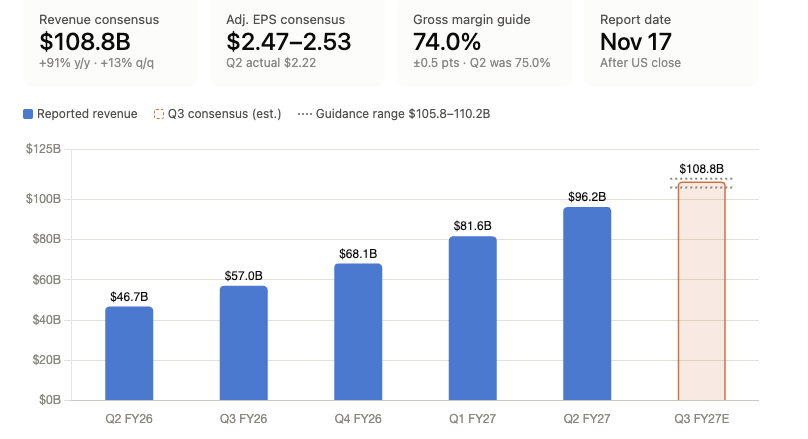
Next week could be particularly important for technology stocks, with Nvidia’s earnings on Tuesday, 17 November, likely to be the main market event. The results arrive at an unusually sensitive moment, following Huang’s departure and the recent correction in AI-related valuations. Investors will be watching whether the company’s underlying business remains strong enough to offset concerns about leadership and corporate governance. Analysts expect about $108.8B in revenue. That’s a little above NVIDIA’s own guidance midpoint of $108.0B (±2%), up 13% on the quarter and up 91% on the year. However, strong results alone may not be enough. Management will need to reassure investors about demand, margins, future product launches and the company’s strategic direction under interim CEO Colette Kress.

The Federal Reserve will remain another major influence. Wednesday’s release of the October FOMC minutes could provide greater clarity on how policymakers view persistent inflation and whether support is building for a more aggressive tightening cycle. Following this week’s CPI surprise, investors have become increasingly sensitive to any indication that the Fed may need to raise rates further into 2027.
Economic data will also be important, particularly Tuesday’s US retail sales figures and Wednesday’s UK inflation report. US retail sales will provide an indication of whether consumer demand remains resilient despite elevated borrowing costs. Stronger spending could reinforce expectations of further Fed tightening, while weaker demand might raise questions about the sustainability of economic growth. In the UK, CPI will be closely watched following the Bank of England’s recent rate hike to 4%. Another upside inflation surprise could strengthen expectations of further tightening, supporting sterling but potentially weighing on gilt prices and domestically focused equities.
Market outlook: Can the recovery survive higher yields?
The main theme heading into next week is the growing tension between resilient corporate earnings and increasingly restrictive financial conditions. The equity rebound suggests investors remain willing to take risks, particularly when they see opportunities following sharp selloffs. However, the rise in Treasury yields and uncertainty surrounding the Fed’s terminal rate could limit further gains, especially for companies whose valuations depend heavily on future earnings growth. Nvidia’s results could prove decisive for the near-term direction of the AI trade, but they will not resolve every concern facing the sector. Strong earnings and reassuring leadership guidance could help restore confidence, while disappointing margins or uncertainty about future demand could revive selling pressure. The more constructive scenario would involve robust corporate results alongside stabilising yields, allowing equities to recover without another significant repricing of interest rate expectations.
For commodities, oil will remain highly sensitive to developments between Washington and Tehran, while gold’s recovery prospects depend heavily on whether real yields and the dollar begin to ease. Ultimately, the next leg in markets is likely to depend on whether earnings growth can continue to outweigh the pressure from higher borrowing costs. With Nvidia reporting and several important economic releases ahead, volatility could remain elevated as investors head towards the final weeks of November.