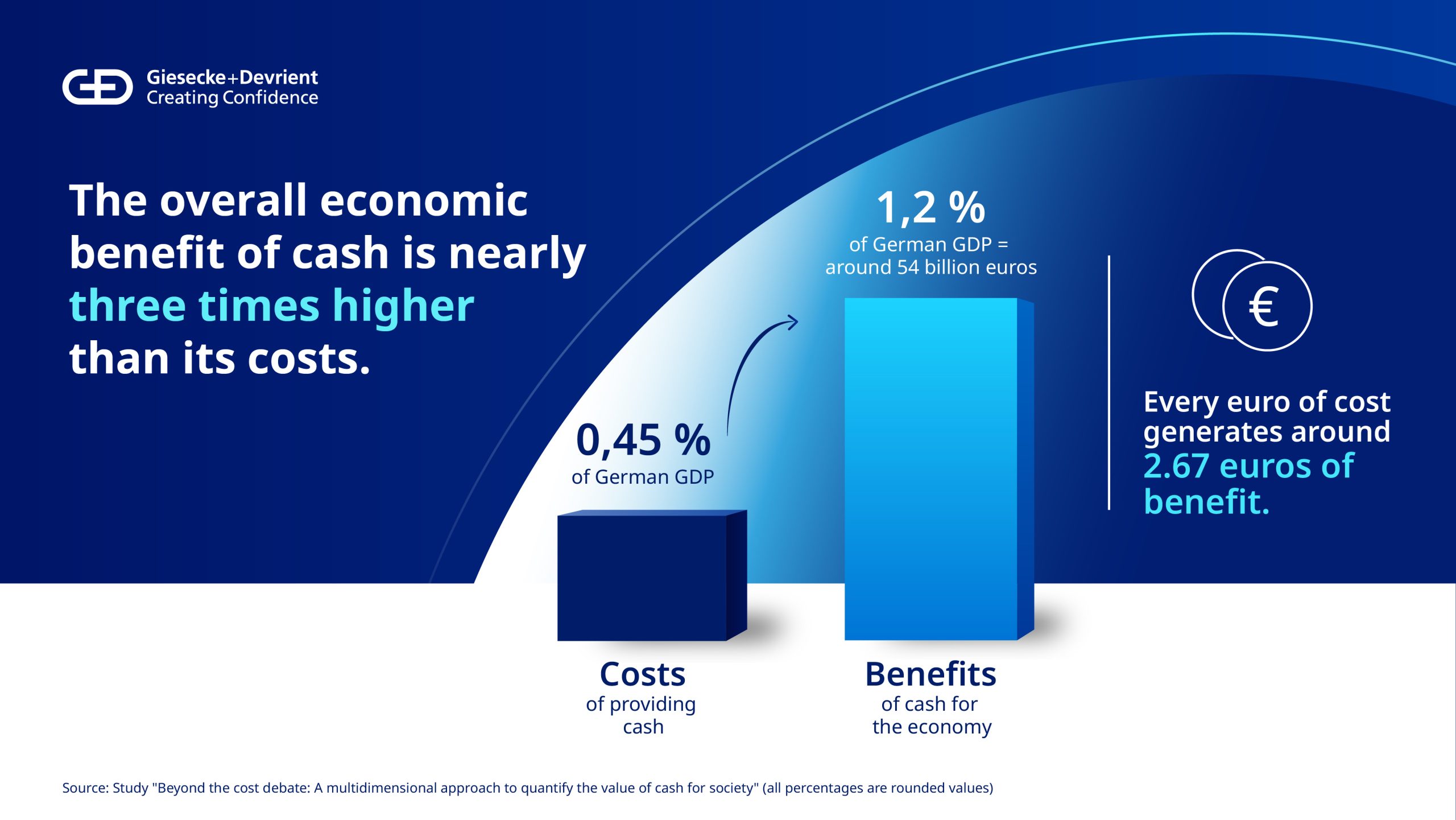
A new independent, scientifically led study has, for the first time, quantified the economic and societal value of cash in monetary terms. Based on a representative survey, the research estimates that the positive effects generated by cash are equivalent to approximately 1.2% of Germany’s GDP, or around €54 billion, while the costs of providing and maintaining the cash infrastructure amount to approximately 0.45% of GDP.
A new study, Beyond the Cost Debate: A Multidimensional Approach to Quantify the Value of Cash for Society, concludes that the overall societal value of cash is nearly three times higher than its costs. Prof. Dr. Julia Pitters, Professor of Business Psychology at IU International University of Applied Sciences and Prof. Dr. Franz Seitz, Professor of Economics at Weiden Technical University of Applied Sciences, served as the scientific lead of the research. The analysis captures a broad range of benefits, including support for local economic activity, payment system resilience, privacy, financial inclusion, and competition in the payments market.
Cash as a key tool for resilience and national security
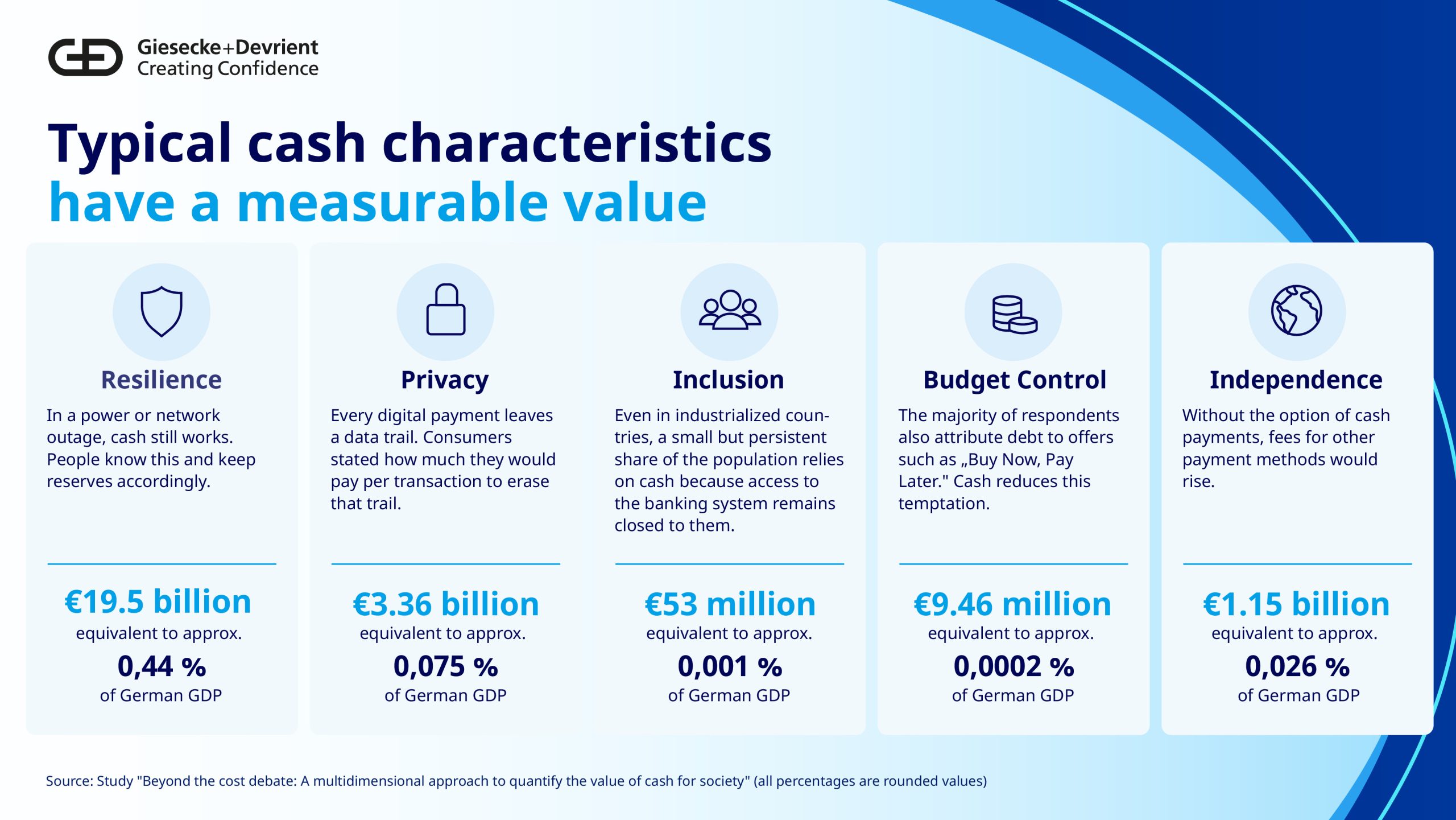
Cash works in times of crisis, during power outages, cyberattacks, or other disruptions and is the most resilient, souverain payment method. Based on respondents’ assessment of appropriate emergency cash reserve, the study estimates this resilience value at around 0.44% of GDP, equivalent to nearly €19.5 billion.
The value of privacy can be quantified
Privacy protection can also be quantified. Half of respondents indicated that they would be willing to pay at least €0.20 per transaction to ensure that data from a digital payment is either not stored or deleted immediately. For Germany in total, this represents a value of more than €3 billion, or 0.075% of GDP.
Cash generates benefits that extend well beyond transactions. It supports financial inclusion, strengthens competition in the payment ecosystem, and helps consumers keep control of their spending. In addition, many people value the convenience and security of cash enough to hold it despite earning no interest. Combined, these benefits are estimated to be worth around 1.2% of Germany’s GDP.
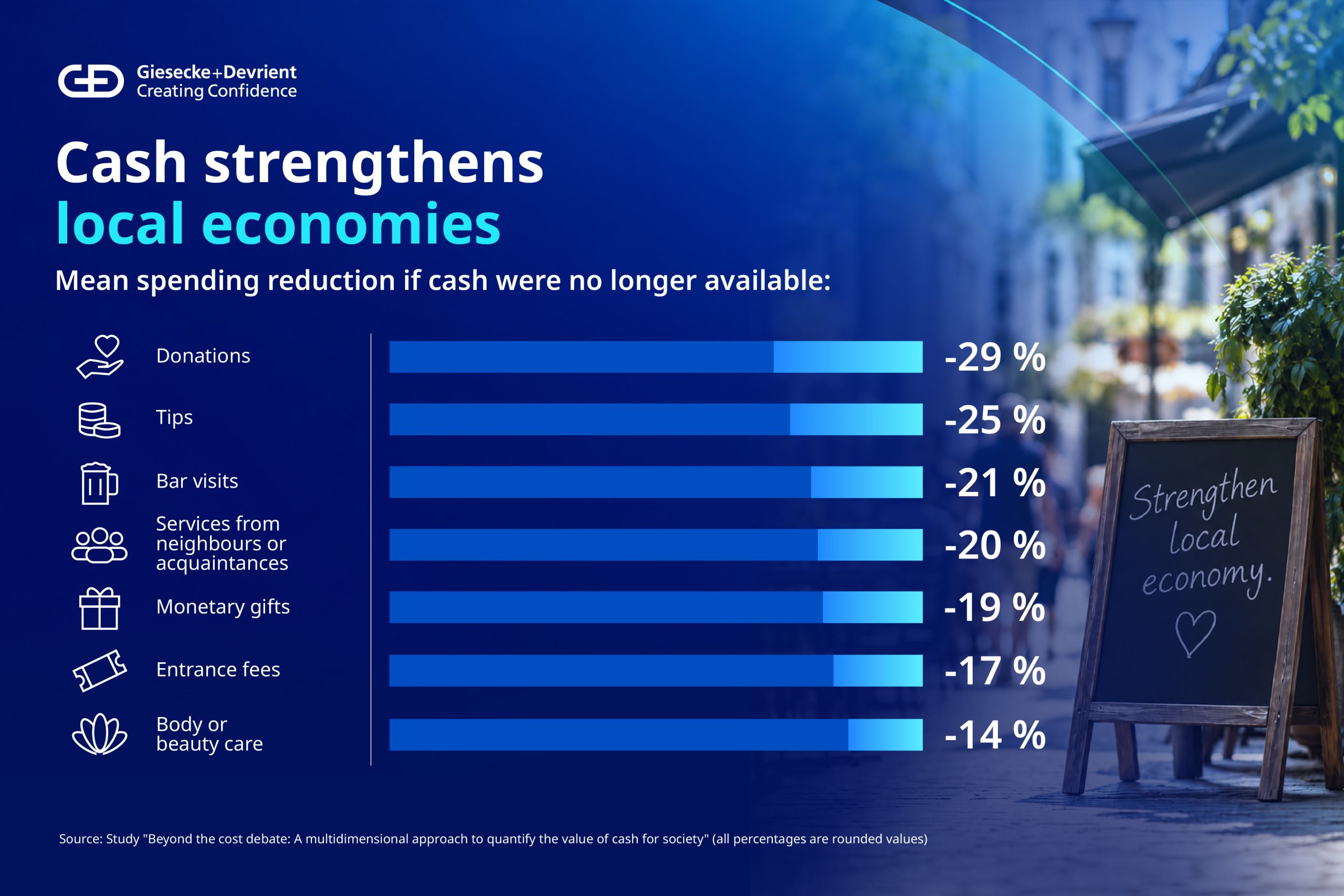
Cash strengthens local economies
A significant share of the benefits generated by cash arises within local economic ecosystems. The study examined how consumer behavior would change if cash were no longer available. Twenty-nine percent of respondents indicated they would donate less in such a scenario, while one quarter said they would leave fewer tips. Respondents also expected lower spending at weekly markets, local festivals, small service providers, and other community-based transactions.
A stronger payment ecosystem through choice
The study does not position cash as an alternative to digital payments. Instead, the findings point to a balanced payment ecosystem in which cash and digital payment methods fulfill different functions and complement one another. It supports more informed policymaking and helps ensure that the evolving payments ecosystem continues to reflect citizens’ needs, preferences, and expectations.
“For decades, discussions about cash have focused on its costs because many of its broader benefits were difficult to measure. Our research shows that cash creates substantial and measurable value through resilience, privacy, inclusion, and local economic activity. Even using a conservative methodology, the societal benefits significantly outweigh the costs,” says Prof. Dr. Julia Pitters, Professor of Business Psychology at the IU-International University of Applied Sciences.
“This study provides the missing information for evaluating the role of cash in modern societies. For the first time, policymakers can assess both the costs and the benefits of cash using a consistent framework” adds Frane Maroević, Director General International Currency Association.
“The future of currency should be shaped by evidence, not assumptions. This study provides central banks and regulators with the data they need to assess the broader value of cash and make informed decisions about forecasting, investment, and resilient payment infrastructure. That is why G+D supports the ICA’s efforts to establish a globally comparable framework for the future of public currency,” highlighted Dr. Wolfram Seidemann, CEO of G+D Currency Technology.
Methodology
The study is based on a representative online survey of 2,006 people aged 16 and older in Germany, conducted in October 2025. The analysis combines survey findings, stakeholder interviews, and macroeconomic data to quantify the societal value of cash across five dimensions: national security and systemic resilience, freedom and privacy, inclusion and universal access, financial control and personal discipline, consumer surplus, competition and independence.