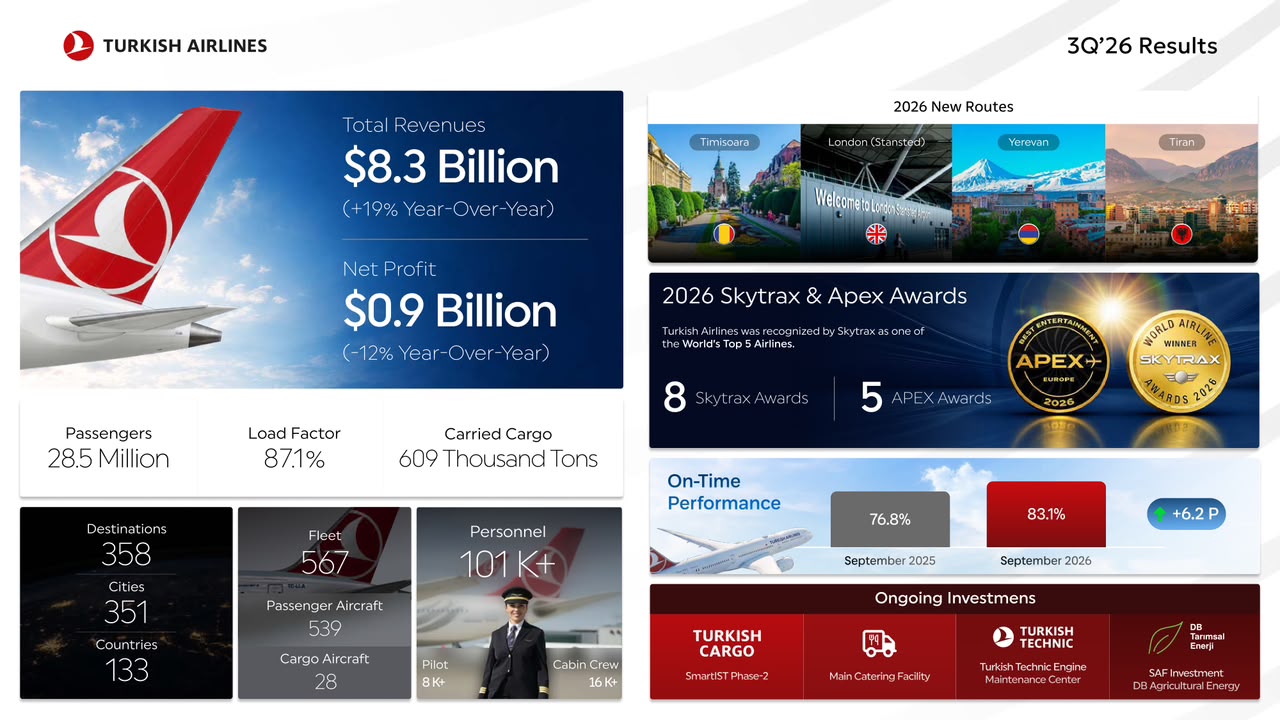
Turkish Airlines reported an operating profit of USD 929 million in the third quarter of 2026, supported by strong passenger demand across key markets, particularly Asia, Europe, and Türkiye.
The airline’s total revenues increased by 19.3% year-on-year to USD 8.3 billion during the July–September period. Passenger load factor also improved by 1.5 percentage points to 87.1%, while the number of passengers carried rose by 4.7% to 28.5 million.
For the first nine months of 2026, Turkish Airlines recorded EBITDAR (Earnings Before Interest, Taxes, Depreciation, Amortization and Rent) of USD 3.7 billion. However, the EBITDAR margin declined by 6.2 percentage points year-on-year to 17.6%, reflecting the impact of higher jet fuel prices and inflationary pressures.
Total investments reached USD 4.6 billion during the first nine months of the year, while consolidated total assets exceeded USD 52 billion.
Global Challenges Affect Aviation Performance
Rising geopolitical tensions and increasing energy costs continued to affect the global aviation industry throughout the third quarter of 2026. Inflationary pressures drove up non-fuel operating expenses, while Turkish Airlines’ jet fuel costs increased by 118% since the beginning of the year.
The ongoing conflict in the Middle East also affected travel demand and operating conditions, prompting the airline to revise its initial target of 10% passenger capacity growth for 2026. Capacity growth reached 3.2% in the third quarter.
Despite these challenges, Turkish Airlines relied on its flexible business model, extensive international network and agile capacity management to respond to changing market conditions and limit the impact of rising costs.
By reallocating capacity towards markets with stronger demand, the airline maintained its position as Europe’s leading network carrier by number of flights. It also achieved growth in passenger numbers and load factors throughout the third quarter.
Passenger and Cargo Revenues Support Financial Results
Growth in both passenger and cargo revenues helped offset part of the pressure caused by rising operating expenses.
Turkish Cargo recorded a 7.4% increase in cargo volumes, while cargo revenues climbed by 45.6% to more than USD 1.2 billion, benefiting from the airline’s extensive logistics infrastructure and strategic geographic position.
Nevertheless, the sharp increase in operating costs, particularly jet fuel expenses, outpaced revenue growth and weighed on operating profitability.
In response, Turkish Airlines intensified its focus on operational efficiency and cost-control initiatives, while selectively reassessing its investment plans.
These measures supported EBITDAR of USD 3.7 billion during the first nine months of 2026, although the margin declined to 17.6%, down 6.2 percentage points compared with the same period last year.
Turkish Airlines Highlights Operational Resilience

Commenting on the third-quarter results, Prof. Murat Şeker, Chairman of the Board and the Executive Committee of Turkish Airlines, said that the conflict in the Middle East and persistently high jet fuel prices had created significant pressure on the global aviation sector.
He emphasized that the airline continued to prioritize operational efficiency and cost discipline while responding to changing demand patterns and capitalizing on opportunities across its extensive flight network.
Şeker noted that the continued monthly growth in passenger numbers and load factors throughout the third quarter demonstrated the resilience of the airline’s flexible business model and operational capabilities, despite the increasingly challenging business environment.
He also highlighted the company’s selective approach to capital allocation, with resources directed towards strategic investments offering strong value creation potential.
Supported by its solid financial position, Turkish Airlines continues to invest in its brand and customer experience. The international recognition reflected in awards from APEX and Skytrax further demonstrates the airline’s commitment to service quality.
He concluded by reaffirming Turkish Airlines’ commitment to operational excellence, stronger global connectivity and sustainable contributions to the aviation industry, while continuing to connect people and cultures worldwide.