President Abdel-Fattah El-Sisi has stressed that maintaining Egypt’s stability requires recognizing the scale of the challenges facing the country, warning that the achievements made in recent years would not have been possible without stability.
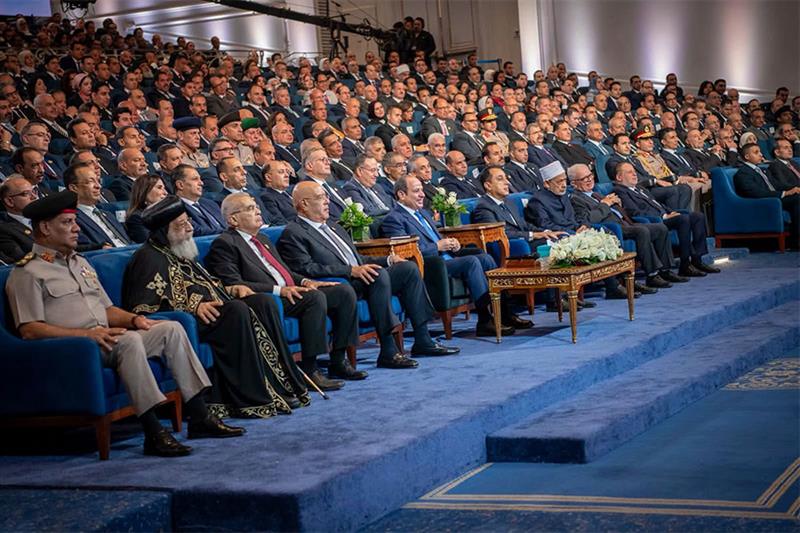
Speaking at Egypt Forum 2026, held at the St. Regis Hotel in the New Administrative Capital under the theme “A Look at Today, a Vision for Tomorrow,” El-Sisi said Egyptians must understand the importance of protecting the state, particularly in light of the challenges the country faced in the past.
“A few days ago, I said they had brought the country to the ground. What does it mean to bring a country to the ground? Without stability, none of what we have achieved would have been possible,” he said.
“I am not trying to frighten you. I have nothing but Egypt. Everyone will go, but Egypt will remain,” the president added.
Preserving the State and Learning from Past Challenges
El-Sisi said his repeated references to the events of 2011 were intended to remind Egyptians of the importance of safeguarding the state, particularly younger generations who did not experience that period firsthand.
While differences of opinion are acceptable, he stressed that protecting the Egyptian state remains a fundamental principle that must not be compromised.
The president also said evaluating the country’s situation requires examining how those responsible for governing it are addressing longstanding problems and challenges.
“If you want to understand your country and feel reassured about it, you must feel secure about those running it, and see whether they are trying to solve problems that were once considered nearly impossible to solve, or not,” he said.
El-Sisi pointed to the sacrifices made by members of the armed forces, police and judiciary in maintaining stability, as well as the victims of attacks on mosques and churches.
He also highlighted the financial and economic costs associated with combating terrorism and maintaining security, reiterating his aspiration for every citizen to earn enough to meet their own needs and support their families.
The president referred to the Suez Canal fund, saying it held EGP 500 billion in cash, while underscoring improved living standards as a central national objective amid continuing economic pressures.
Egypt Forum Seeks to Highlight National Achievements
El-Sisi said the forum was organized to present achievements across different state sectors and examine the scale of the transformation Egypt has undergone in recent years.
“We wanted to present what has been accomplished across all sectors of the state and review where we were and where we are now,” he said.
He explained that preparations prioritized the provision of accurate and comprehensive government data, encouraging different viewpoints and allowing criticism to be heard.
The president urged citizens to follow the forum’s discussions throughout the week to gain a clearer understanding of completed projects, current challenges and government plans for the coming period.
El-Sisi Calls for Moderation in Mobile Phone and Social Media Use
The president also called for a balanced approach to mobile phone and social media use, warning against excessive screen time, particularly among children and young people.
“I sit with my grandchildren and see them on their phones as well. I keep saying that balance in the use of phones and social media is necessary,” he said.
“Moderation is required in everything. Do not spend five or six hours on the phone. Excess is not limited to food and drink; it also applies to social media,” El-Sisi added.
He warned that social media could be used to isolate individuals and mobilize groups against their own countries, stressing the responsibility of Egyptian families to balance technological progress with appropriate supervision of children’s digital activities.
Madbouly Pledges Government Action Programme Through 2030
Prime Minister Mostafa Madbouly said the government would respond to citizens’ questions about public policies, including national debt, infrastructure spending, the New Administrative Capital and the outlook for Egypt’s economy following its programme with the International Monetary Fund (IMF).
“We respond to the concerns, criticisms and proposals of Egyptian society,” Madbouly said, describing the forum as an opportunity to hear public criticism, reassess priorities and engage with opposition figures, politicians and public personalities.
He stressed that improving living standards remained the government’s central objective, within the limits of available resources.
According to Madbouly, the forum’s website had attracted 17 million views and more than 61,000 registrations, generating over 16,000 ideas and proposals from citizens.
Around half of those registered were between 18 and 35 years old, including more than 5,000 students, some of whom were still in school. The submissions generated more than 42 questions reflecting public concerns, which were displayed on screens inside the conference hall.
These included questions about the rationale behind constructing the New Administrative Capital, whether spending on roads and bridges should instead have been directed toward healthcare and education, how Egypt would address its debt burden, and what economic prospects would look like after the IMF programme.
“All these questions will be answered during the forum’s sessions,” Madbouly said, adding that ministers and government officials would address public concerns while presenting the state’s achievements.
Preparatory consultations included approximately 4,000 academics participating in 30 sessions across 28 Egyptian universities, alongside opinion surveys and discussions with citizens, young people, investors and private-sector representatives. Education accounted for 23% of the concerns identified, while prices and inflation were also among the leading issues.
Madbouly said the discussions would assess what had been achieved, what remained incomplete and which areas required further action. Their conclusions would feed into an implementation programme extending to 2030, with defined priorities, timelines and mechanisms for monitoring progress.
Infrastructure and Social Protection in Focus
A filmed presentation featuring television presenter Sherif Madkour highlighted a range of government initiatives, including the Asmarat housing development, transport and electricity projects, comprehensive health insurance, and the Takaful and Karama cash-support programme.
The presentation positioned infrastructure development and social protection as interconnected elements of the government’s efforts to improve living standards.
The forum is organized around four main themes: human development; integrated development and quality of life; social protection and societal security; and the economy.
Its sessions and workshops address national policy priorities as well as everyday concerns, including urban greening, stray animals and issues affecting Egyptians living abroad.
Education, Healthcare and National Identity Take Centre Stage
Education was the first major policy issue discussed following the opening ceremony, with a roundtable attended by Madbouly examining whether school education adequately prepares children for university and employment.
The discussion covered teaching methods, curricula, assessment systems and the skills needed for future jobs.
A presentation outlined education reforms, including programming and financial education, the Egyptian Baccalaureate system, and the expansion of applied technology schools through partnerships with industry.
Another presentation highlighted the growth of Egypt’s higher education network to 131 institutions, including 14 technological universities, alongside initiatives such as the Egyptian Knowledge Bank and programmes supporting innovation.
The discussions focused on improving educational quality and access while strengthening the links between university programmes, research, innovation and labour-market needs.
Healthcare and scientific research also featured prominently in the opening programme. A film included a contribution from renowned heart surgeon Magdi Yacoub, who praised El-Sisi’s attention to public health and described healthcare, science and research as fundamental to societal progress.
Journalist Ibrahim Eissa called for open exchanges in which citizens and officials could engage across differing viewpoints. Television presenter Lamees El-Hadidi stressed that national ambitions must reflect citizens’ aspirations, while opening presenter Jasmine Taha Zaki said an honest assessment of current conditions was essential to shaping future development.
The forum’s discussions also addressed national identity and the modernization of state institutions. Mohamed Kamal emphasized competence, expertise and strategic balance in foreign policy, while researcher Maha Bassiouni highlighted the importance of learning from past mistakes. Historian Ibrahim El-Assal discussed Egypt’s contributions to Islamic civilization and the significance of its Egyptian and Arab identity.
Digital Literacy and Responsible Use of Artificial Intelligence
The opening programme also examined the influence of social media on public debate and social cohesion.
In a recorded contribution, satirist Bassem Youssef warned that online platforms could turn disagreements into hostility between Arab societies, including disputes over football and discussions involving Syrians and Sudanese living in Egypt.
Youssef said social media had helped build his career but had also created difficulties, contrasting online antagonism with the positive interactions he experienced with audiences from different Arab nationalities.
He cautioned against accounts that inflame divisions while claiming to represent entire populations.
Yasmina El-Abd highlighted the risks of accepting search results and artificial intelligence-generated answers without verification, urging users to question sources and assess information critically.
Psychiatrist Mohab Megahed discussed how provocative online content can encourage repeated and compulsive engagement, while entrepreneur Mohamed Abou El-Naga called on young people to develop practical skills and turn artificial intelligence into projects and employment opportunities.
He cited a training initiative involving approximately 16,000 people, of whom 10,000 developed projects and 1,000 generated commercial results by selling their products.
Economic Transformation Programme to Extend Through 2030
Economic policy is scheduled to feature prominently on the forum’s fourth day, with the government expected to outline its priorities for the period through 2030.
Cabinet Spokesman Mohamed Adel said the proposed economic transformation programme would focus on raising productivity, attracting private investment, supporting small and medium-sized enterprises, and promoting entrepreneurship.
The programme also aims to create greater fiscal space to support spending on essential public services.
Madbouly said the forum’s discussions would help translate public proposals into a practical implementation programme, with clear priorities, timelines and mechanisms to monitor results through 2030.
The coming sessions are expected to examine which policies should continue, which require adjustment, and how economic and social initiatives can deliver tangible improvements in citizens’ daily lives.