In the heart of one of Europe’s most spirited capitals, Brach Madrid brings together design, gastronomy, wellbeing, and Madrid’s unmistakable energy. Located at number 20 on Madrid’s iconic Gran Vía, one of the capital’s most celebrated avenues, the hotel puts guests within easy reach of the city’s cultural landmarks, renowned neighbourhoods, shopping destinations, and some of its most recognisable architecture, while creating a world of its own behind its white-stone façade.
A Madrid Home Imagined by Philippe Starck
Completed in 1922, the seven-storey building has a story that stretches well beyond its life as a hotel. The site was once home to the Palacio de Masserano, where Victor Hugo lived as a child, while the present building later housed the studios of the Alfonso family, a renowned dynasty of Spanish photojournalists. Today, its restored architecture provides the setting for Philippe Starck’s interpretation of Madrid, drawing inspiration from the 1920s and 1930s while avoiding a literal recreation of the past.
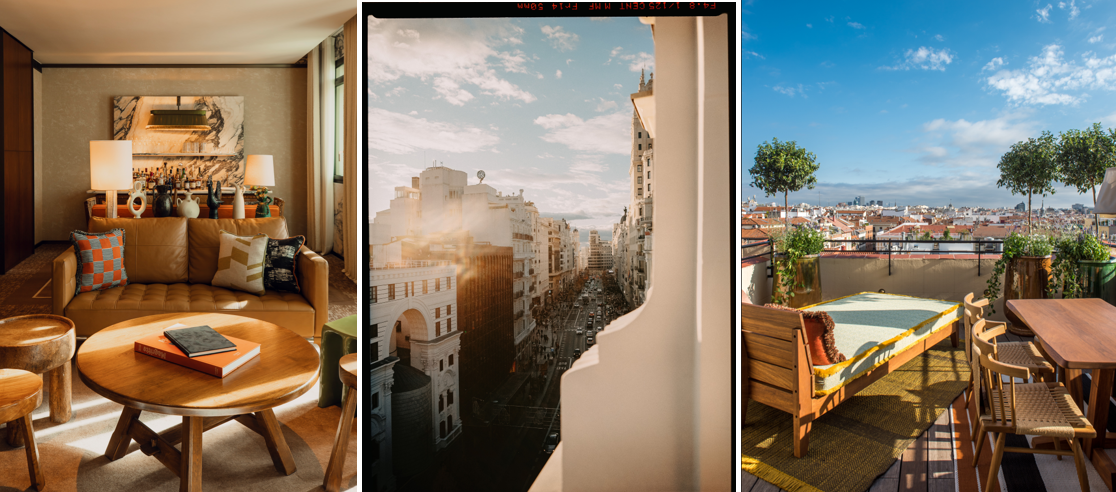
Inside, Starck creates what feels less like a conventional hotel and more like an intriguing private residence shaped over time. Terracotta, dark woods, leather, ceramics and natural fibres are layered with paintings, photographs, books and collected objects, giving the interiors a sense of memory and personality. Contrasts run throughout: the earthy terracotta of the lobby gives way to the lightness of the wellness spaces, while woven leather and rich mahogany in the restaurant sit alongside art and unexpected decorative pieces.
Rooms with the Character of a Private Residence
An intimate boutique hotel, Brach Madrid features 57 rooms and suites, offering a sense of privacy and warmth in the heart of Madrid. Accommodation spans three room categories — Superior, Deluxe and Executive — each offering a different sense of space while sharing the same distinctive design language. Warm wood panelling, hand-finished leather, ceramics and carefully chosen objects create intimate interiors inspired by Mediterranean warmth.
For guests seeking more space, the hotel offers three suite categories: Armando, Ernesto and Antonio; each featuring its own terrace overlooking Madrid. Varying in size and layout, the suites offer generous living spaces enriched with warm woods, leather, artwork and carefully selected objects, continuing the distinctive design and intimate atmosphere found throughout Brach Madrid.
Beyond the guestrooms, Brach Madrid offers a lively restaurant, bar and French pâtisserie, with the restaurant drawing inspiration from Madrid’s historic grand cafés and led by Executive Chef Adam Bentalha. For relaxation, the 400-square-metre Spa & Sports Club features a 20-metre indoor pool, fitness spaces and treatment rooms in a serene white-and-gold setting.
Step Outside: The Energy of Gran Vía
Leaving Brach Madrid means stepping directly onto one of the Spanish capital’s most emblematic avenues. Built between 1910 and 1931, Gran Vía played an important role in Madrid’s modernisation and today remains one of its great urban showcases, where monumental architecture sits alongside theatres, cinemas, cafés, restaurants and shopping.
The wider Sol–Gran Vía district forms one of the centres of Madrid’s cultural, recreational and commercial life. Its streets are made for exploring on foot, moving between historic architecture and contemporary city life, independent addresses and major stores, cafés and cultural institutions.
A short stroll leads towards Puerta del Sol, one of Madrid’s most recognisable meeting places and home to Spain’s Kilometre Zero, the official point from which road distances across the country are measured, as well as the famous Bear and Strawberry Tree statue. Continue through the historic centre and the city reveals Plaza Mayor, one of its great 17th-century public squares, surrounded by the streets and traditional addresses of old Madrid.
In the opposite direction along Gran Vía and Calle de Alcalá, architecture and culture take centre stage. The Círculo de Bellas Artes hosts exhibitions, concerts and cultural events, while nearby stand the distinctive Metrópolis Building and the monumental Plaza de Cibeles, dominated by its famous fountain and the early 20th-century Cibeles Palace.
From the Prado to El Retiro
Just minutes from the hotel, Madrid’s celebrated art district offers another side of the capital. The tree-lined Paseo del Prado brings together some of the city’s most important cultural institutions, including the Prado Museum and Thyssen-Bornemisza Museum, alongside the Royal Botanical Garden. Together with El Retiro Park, the area forms part of Madrid’s UNESCO-listed Landscape of Light.
After a morning devoted to art, El Retiro Park offers an entirely different rhythm. Visitors can wander its tree-lined paths, pause beside the lake or discover landmarks such as the Glass Palace and the monument to Alfonso XII. It provides a green pause within the capital before returning to the movement and energy of Gran Vía.
From the historic streets around Puerta del Sol to Madrid’s museums, monumental avenues, boutiques, cafés and green spaces, much of the character of the capital unfolds around Brach Madrid. The result is a stay that extends naturally beyond the hotel itself: a private, design-led retreat at its centre, with Madrid waiting immediately outside.